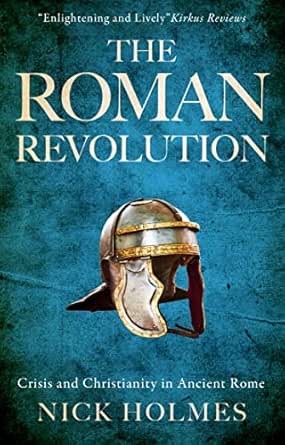
The Roman Revolution

Author: Nick Holmes

Category: History, Politics & Culture

Regular price: $6.99

Deal price: $0.99

Deal starts: April 01, 2026

Deal ends: April 01, 2026

Description:

An enlightening and lively interpretation of an important but neglected historical period.' Kirkus ReviewsIt was a time of revolution.The Roman Revolution describes the little known “crisis of the third century”, and how it led to a revolutionary new Roman Empire. Long before the more famous collapse of the Roman Empire in the fifth century, in the years between AD 235-275, barbarian invasions, civil war and plague devastated ancient Rome. Out of this ordeal came new leaders, new government, new armies and a new vision of what it was to be Roman. Best remembered today is the rapid rise of Christianity in this period, as Rome's pagan gods were rejected, and the emperor Constantine converted to this new religion. Less well remembered is the plethora of other changes that conspired to provide an environment well suited to a religious revolution.Drawing on the latest research, Nick Holmes looks for new answers to old questions. He charts the rise of the Roman Republic and the classical Roman Empire, examining the roles played by sheer good luck and the benign climate. For example, he emphasises the unexpected death of Alexander the Great and the subsequent weakness of the Greek successor states as the ideal political environment for Rome's expansion. But Rome's good fortune did not last. The rise of Sasanian Persia, the growing strength of the German barbarians, and the brutal effects of the Antonine plague caused the near collapse of the Roman Empire in the third century. Focusing on the reigns of the critically important but under-researched emperors in the third century, such as Aurelian, Diocletian and Constantine, he vividly brings to life how Rome just escaped catastrophe in the third century, and embarked on a journey that would take it into a brave new world - one which provided the foundations for modern Europe and America.This book is the first of a multi-volume series that will chart the full course of the Fall of the Roman Empire from the third century AD to the seventh. The second book, The Fall of Rome, continues the story of Rome's decline up to the sack of Rome by Alaric the Goth in AD 410. The third book, Rome and Attila, covers the period from 410 to the western empire's final demise in AD 476. Further books will look at the Roman reconquest of Italy and North Africa under the Emperor Justinian in the sixth century, followed by the rise of Islam and the demise of the Eastern Roman Empire in the seventh century.

The Forbidden Idea

Author: Mark Monoscalco

Category: History, Politics & Culture

Regular price: $9.99

Deal price: $0.99

Deal starts: March 17, 2026

Deal ends: March 18, 2026

Description:

Some ideas are forbidden not because they are false—but because they threaten the foundations of power.

In an age of expanding government, managed narratives, and pressure to conform to an evolving moral orthodoxy, the principles that once defined a free society are increasingly dismissed, distorted, or suppressed. The Forbidden Idea confronts this erosion by asking a deeper question than most political debates ever reach:

Do you believe in coercion, or do you believe in individual liberty?

A foreword by Dr. Ron Paul sets the tone. Drawing on political philosophy, natural law, economics, and history, Mark A. Monoscalco presents a rigorous yet accessible defense of individual liberty grounded in consent, moral agency, and voluntary cooperation. Rather than framing individual liberty as merely a policy preference or cultural slogan, this book argues that it is a moral necessity for any just society.

Unlike conventional political books that argue about what government should do, The Forbidden Idea examines whether government has the moral right to do it at all.

What makes this book different:

Most discussions of individual liberty stop at policy. This one begins with first principles.

The book compares individual liberty with its major philosophical rivals—central planning, collectivism, utilitarianism, and authority-based moral systems—and explains why societies built on coercion, even when well-intentioned, inevitably undermine both prosperity and human dignity.

This book invites readers to rethink what individual liberty actually requires and what is lost when it is compromised.

Inside, you’ll explore:

Why consent is the foundation of legitimate social order
How natural law and natural rights define the limits of political power
Why economic freedom is inseparable from moral and political liberty
How spontaneous order explains cooperation without central control
The cultural and psychological roots of collectivism and centralized authority
The moral case for individual responsibility over state authority

The Forbidden Idea is written for readers who are new to the philosophy and history of individual liberty. This book will also resonate with readers of The Law, The Road to Serfdom, and The Ethics of Liberty.

This is not a call to outrage. It is a call to clarity—about what individual liberty truly requires, what coercion destroys, and why the belief that human beings are not owned remains the most dangerous idea in politics.

If you are ready to understand individual liberty not as a slogan but as a coherent moral philosophy, The Forbidden Idea will permanently change how you see power, society, government, and yourself.

About the book cover:

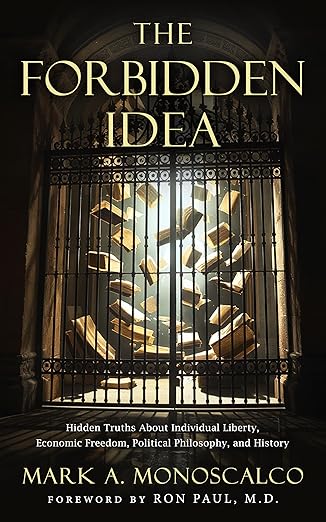
Some words are closely related in meaning, such as light and enlightenment or darkness and ignorance. Darkness cannot resist light—it disappears when light is present. In the same way, ignorance cannot resist enlightenment; it fades when understanding is introduced.

From the perspective shown on the book cover, you stand outside the gates, surrounded by darkness—a symbol of ignorance. The elites of society want to keep you there, unaware of the ideas that could set you free. Behind the gates, the books glow with light, representing knowledge that brings enlightenment—The Forbidden Idea. To escape the darkness, read this book.

Read more

The Forbidden Idea

Author: Mark Monoscalco

Category: History, Politics & Culture

Regular price: $9.99

Deal price: $0.99

Deal starts: March 17, 2026

Deal ends: March 17, 2026

Description:

Some ideas are forbidden not because they are false—but because they threaten the foundations of power.

In an age of expanding government, managed narratives, and pressure to conform to an evolving moral orthodoxy, the principles that once defined a free society are increasingly dismissed, distorted, or suppressed. The Forbidden Idea confronts this erosion by asking a deeper question than most political debates ever reach:

Do you believe in coercion, or do you believe in individual liberty?

A foreword by Dr. Ron Paul sets the tone. Drawing on political philosophy, natural law, economics, and history, Mark A. Monoscalco presents a rigorous yet accessible defense of individual liberty grounded in consent, moral agency, and voluntary cooperation. Rather than framing individual liberty as merely a policy preference or cultural slogan, this book argues that it is a moral necessity for any just society.

Unlike conventional political books that argue about what government should do, The Forbidden Idea examines whether government has the moral right to do it at all.

What makes this book different:

Most discussions of individual liberty stop at policy. This one begins with first principles.

The book compares individual liberty with its major philosophical rivals—central planning, collectivism, utilitarianism, and authority-based moral systems—and explains why societies built on coercion, even when well-intentioned, inevitably undermine both prosperity and human dignity.

This book invites readers to rethink what individual liberty actually requires and what is lost when it is compromised.

Inside, you’ll explore:

Why consent is the foundation of legitimate social order
How natural law and natural rights define the limits of political power
Why economic freedom is inseparable from moral and political liberty
How spontaneous order explains cooperation without central control
The cultural and psychological roots of collectivism and centralized authority
The moral case for individual responsibility over state authority

The Forbidden Idea is written for readers who are new to the philosophy and history of individual liberty. This book will also resonate with readers of The Law, The Road to Serfdom, and The Ethics of Liberty.

This is not a call to outrage. It is a call to clarity—about what individual liberty truly requires, what coercion destroys, and why the belief that human beings are not owned remains the most dangerous idea in politics.

If you are ready to understand individual liberty not as a slogan but as a coherent moral philosophy, The Forbidden Idea will permanently change how you see power, society, government, and yourself.

About the book cover:

Some words are closely related in meaning, such as light and enlightenment or darkness and ignorance. Darkness cannot resist light—it disappears when light is present. In the same way, ignorance cannot resist enlightenment; it fades when understanding is introduced.

From the perspective shown on the book cover, you stand outside the gates, surrounded by darkness—a symbol of ignorance. The elites of society want to keep you there, unaware of the ideas that could set you free. Behind the gates, the books glow with light, representing knowledge that brings enlightenment—The Forbidden Idea. To escape the darkness, read this book.

Read more

The Mongol Empire

Author: John Man

Category: History, Politics & Culture

Regular price: $10.99

Deal price: $0.99

Deal starts: March 04, 2026

Deal ends: March 04, 2026

Description:

Genghis Khan is one of history's immortals: a leader of genius, driven by an inspiring vision for peaceful world rule. Believing he was divinely protected, Genghis united warring clans to create a nation and then an empire that ran across much of Asia.Under his grandson, Kublai Khan, the vision evolved into a more complex religious ideology, justifying further expansion. Kublai doubled the empire's size until, in the late 13th century, he and the rest of Genghis’s ‘Golden Family’ controlled one fifth of the inhabited world. Along the way, he conquered all China, gave the nation the borders it has today, and then, finally, discovered the limits to growth.Genghis's dream of world rule turned out to be a fantasy. And yet, in terms of the sheer scale of the conquests, never has a vision and the character of one man had such an effect on the world.Charting the evolution of this vision, John Man provides a unique account of the Mongol Empire, from young Genghis to old Kublai, from a rejected teenager to the world’s most powerful emperor.

What My Mother Gave Me

Author: Elizabeth Benedict

Category: History, Politics & Culture

Regular price: $17.99

Deal price: $0.50

Deal starts: November 08, 2025

Deal ends: November 08, 2025

Description:

New York Times Bestseller: "A winning collection" of essays by daughters including Elinor Lipman, Margo Jefferson, Jean Hanff Korelitz, Lisa See, and more (Kirkus Reviews).
Each of these thirty-one "beautifully crafted" essays (Publishers Weekly) is a story about a mother's gift to a daughter—one that touched her, taught her something, or symbolized a unique bond. Whether a gift was meant to keep a daughter warm, instruct her in the ways of womanhood, encourage her talents, or just remind her of a mother's love, each story gets to the heart of a relationship.
Rita Dove recalls the box of polish that inspired her to paint her nails in the stripes and polka dots she wears to this day. Lisa See writes about the gift of writing from her mother, Carolyn See. Cecilia Muñoz remembers the wok her mother gave her and a lifetime of family meals. Judith Hillman Paterson revisits the year of sobriety her mother bequeathed to her when Paterson was nine, the year before her mother died of alcoholism. Abigail Pogrebin describes her middle-aged bat mitzvah, for which her mother provided flowers after a lifetime of guilt for skipping her daughter's religious education. Margo Jefferson writes about her mother's gold dress from the posh department store where they could finally shop as black women.
Collectively, the pieces have a force that feels as elemental as the tides: outpourings of lightness and darkness; love and rage; joy and grief. From literary prize winners, bestselling authors, and other celebrated women, they are "as varied and unexpected and eloquent and moving as mother love itself" (Cathleen Schine, New York Times-bestselling author of The Grammarians).
Read more

The Gold Train

Author: Ronald Zweig

Category: History, Politics & Culture

Regular price: $4.99

Deal price: $0.99

Deal starts: October 31, 2025

Deal ends: October 31, 2025

Description:

In 1944, as the Soviet army closed in on Budapest, a mysterious train rolled out of the station. On that train were carriage after carriage of loot – gold, diamonds, furs, wedding rings – plundered in one of the most shameful crimes of the century. Commanded by Árpád Toldi, a key organizer of the Hungarian Holocaust, and harbouring a desperate group of fascist ideologues, soldiers and thieves, the gold train was destined for a Nazi stronghold in the Alps. It would never arrive.
Along its crazed journey the train’s contents were pilfered, fought over, hidden and scattered, until they became the stuff of legend, with legal claims unresolved even today. What is the truth of this mythical cargo?
In The Gold Train, Ronald Zweig reveals the full story of one of the most terrible mysteries of the Second World War.
Praise for The Gold Train: ‘An amazing saga...this page-turner will leave you sorrier and wiser’ - David Cesarani, The Independent ‘An excellent account: calm, dispassionate and well written...strips away the myth and exposes the real story in all its brutality and confused, naïve cupidity’ - Alan Judd, Daily Telegraph ‘Poignant... brilliantly told... makes compelling reading’ - Geoffrey Alderman, The Guardian Ronald Zweig is the Taub Chair of Israel Studies at New York University and Director of the Taub Center for Israel Studies.